

One of the more common things I see folks get confused on is the rank structure of the Navy and the jobs sailors held. While the Army and the Marines have some commonality in rank titles and insignia, the Navy (with exception to the Coast Guard) is its own sea creature. Many of the names and titles associated with Navy jobs are based on tradition and heavily influenced by new technology. In an effort to make this an easier reference, I am focusing on the enlisted side of things in the WWII-era as there is plenty on this topic alone to explain… and get confued about.
Terms To Know.
First, I need to clarify some terms up that you will need to know so you have a better understanding going forward.
- Rating – This is a sailor’s specialty in the Navy. Think of this like the modern MOS system in other services. Sailors who have a rating are considered “rated men.”
- Rate – For the lay person, think of rate as rank. But, officially and still true today, officers in the Navy have rank and the enlisted have rates.
- Paygrade – This is the level of pay a sailor made. Unlike today, paygrades did not necessarily correlate to rate and varied by rating. Paygrades were numbered with the 1st paygrade being the highest in pay.
- Nonrated – A sailor without a specialty rating, usually within the first three paygrades. Sometimes referred to as unrated.
- Striking – The process of an unrated sailor learning a rating through on-the-job training. A sailor in this program is considered a ‘striker.’
- Branch – Navy specialties during WWII were grouped into seven branches: Seaman, Engine Room Force, Artificer, Aviation, Special, Commissary, and Messman & Steward. A sort of eighth branch for Specialists was temporarily created for specialties not covered by current rates to meet wartime needs.
Let’s start by going over the basic structure of Navy rates. Below is an illustration of rates and ranks pulled from the Bluejackets’ Manual of 1944.
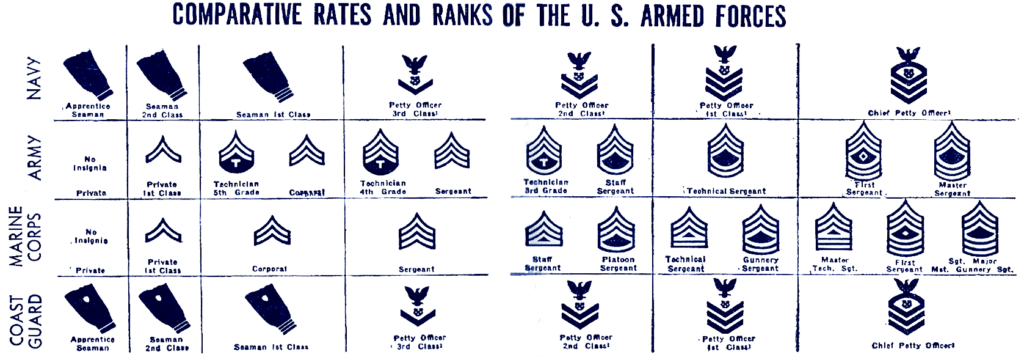
Looking at that chart, things look pretty straight forward, right? Well… hold fast! Things are about to get confusing.
Pay Grades.
Going off the chart above, each column would represent a grade, which translates to pay… hence pay grade. You can see that there are seven columns but there were technically eight enlisted paygrades at this time when you include the Acting or Appointed Chief Petty Officer Pay Grade. As you can see in the chart below, paygrades were not standardized in regards to the ‘nonrated’ sailors at the start of the war.
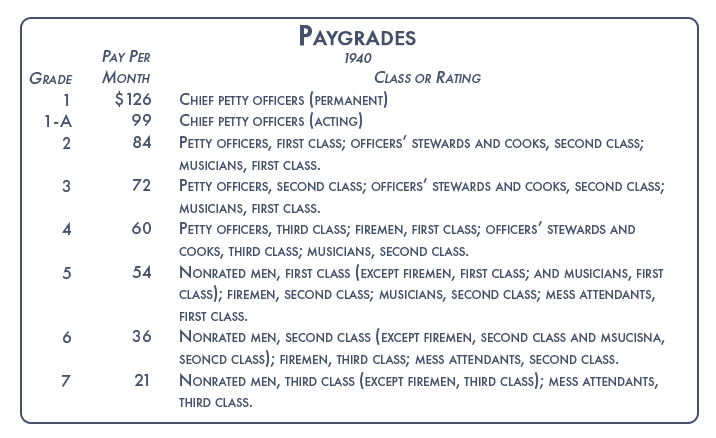
One thing to remember is that pay grades are just simply that: grades of pay. They are not good indicators of authority as some jobs were set higher in pay grade due to their technical or physical difficulty. During the period between 1940 and the end of 1943, a seaman 2c and a fireman 2c were technically at the same level of authority but they were not paid equally. This was to meant to compensate the fireman’s more technical job. An unrated fireman 1c could be paid the same as a petty officer 3c and musician 1c could be paid the same as a petty officer 2c!
Obviously, this is very confusing to us… and the Navy must have thought the same because on January 1, 1944, pay grades were standardized across the board:
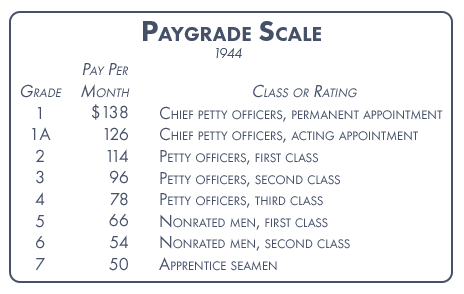
You will notice that in both pay grade charts, there are two levels for chief petty officer: permanent and acting. In order to meet the wartime demands in manpower but not blow the budget, acting appointments were given. These appointments were temporary and essentially for the duration of the war. To make an acting appointment permanent, the chief would have to apply and be recommended by leadership. Approval was proponent to there being a need for his rate by the Navy. If this wasn’t possible, then the sailor would revert to a rate more applicable to his experience and time in service, but this wasn’t an issue until after the war.
Navy Enlisted Branches
Okay, we now see the framework of how the enlisted sailors were structured by rate. Let’s take a look at how they were trained and employed. The entire enlisted force was divided up by seven different branches. Each branch is comprised of related specialties with their own training pipelines. These branches were Seaman, Artificer, Engine Room Force, Special, Commissary, Aviation and Messman (later renamed Steward). Technically, the Engine Room Force was a part of the Artificer branch, but is often listed autonomously. An eighth branch was established for new Specialist ratings created during the wartime emergency in order to fill crucial roles which did not fall within the other branches.
The Seaman branch comprised of what sailors today call ‘topside’ ratings, such as Gunner’s Mates and Boatswain’s Mates. The Artificer branch included ratings that repaired or manufactured things, such as Carpenter’s Mates and Painters, but also included other technical rates like Radiomen and Radarmen. The Engine Room Force was filled with rates specifically related to the operation engines and machinery that kept the fleet powered and moving. The Special branch included support ratings, such as Pharmacist’s Mates, Yeomen and Storekeepers. Commissary branch specifically comprised of food service for the crew, whereas the Messman/Steward branch was focused solely on officer’s wardroom support. The Aviation branch is, of course, focused on the handling of aircraft, but do know that Photographer’s Mates were also a part of this section because the Navy initially used photographers for air reconnaissance. Lastly, the Specialist branch covers every other odd-end technical rating created during the war that didn’t quite fit within the other existing ratings. Overall, a few ratings did shift from one place to another, but the majority of them stayed in the same branch throughout the war.
Rated vs. Nonrated
Let’s clarify what it means to be ‘rated,’ or to have a rating. Ratings are job specialties such as Boatswain’s Mate, Gunner’s Mate, Water Tender, etc. Those who qualified in a rating are considered “rated” and, conversely, those without ratings are considered “nonrated” or “unrated.” Simply put, all petty officers have ratings and are thus rated; there are no nonrated petty officers. One way that helped me remember this is to think of a vehicle: one that has been “rated” with a safety “rating” is better than one without; the higher its “rate” of speed, the quicker you’ll get to where you want to go (more pay and career retirement).
There are seven nonrated grades: Seaman, Fireman, Hospital Apprentice, Bugler, Musician and Mess Attendant (later renamed Steward’s Mate in 1943). The nonrated grade for every branch and rating was Seaman with the following exceptions: Firemen were assigned to the Engine Room Force only, Hospital Apprentice was the nonrated class specific to the Pharmacist’s Mate rating. For the musical ratings, the nonrated Buglers progressed to become Buglemasters while Musicians followed their own rating structure. This later changed in 1944 when Bugler denoted the nonrated grade for both Buglemaster and Musician ratings. Mess Attendants and Steward’s Mates were specific to the Messman/Steward branch ratings.
Though these are not ratings, they do have rates of 3rd, 2nd and 1st class. You’ll sometimes see reference to sailors being ‘rated’ or hold ‘ratings’ in these categories, such as “this man is rated Seaman 2nd Class” or “he held a rating of Bugler 1st Class.” Also, while it’s safe to assume that anyone below Petty Officer 3rd Class is nonrated, there is sometimes an exception to this rule and which I will describe later.
There are three avenues in which a sailor can become rated: by completing a service school, through a direct appointment, or by ‘striking’ for a rate once they’re in the fleet. Determining which path a sailor took all began with the Classification Interview.
The Classification Interview.
Every enlisted sailor during WWII entered the Navy as an Apprentice Seaman (AS), the lowest in the eight wartime pay grades. Upon arrival at a Naval Training Station (aka, boot camp) a physical screening was conducted to see if the recruit met Navy standards, which had stricter standards than the induction center’s physical screening. Each recruit would take a written exam and would meet with a classification interviewer usually within the first two weeks. This person would then determine how America’s newest sailor would be trained in order to meet the needs of the Navy.
The classification interviewer (which was also a rating: Specialist C) basically defined your service. He would take in consideration the recruit’s exam scores, his physical screening results, previous education, and prior work experience as well consider his personal interests, and would then determine if the sailor would go on to further training after boot camp. If the sailor was not a good match for any service schools, or the need for personnel in the fleet were too immediate, the sailor would be directly assigned to a command shortly after graduation from recruit training. Though there were minimum scores listed for each rating or school, some flexibility was given to the interviewer to waive lower scores if an overall impression was made that the sailor would be still be a good fit for a specific rating. The interviewer had a lot of influence on the kind of Navy experience a sailor was going to have based on very cursory information and one’s first impression.
Interviewers also had authority to directly apply ratings to qualifying sailors. Those with civilian education and work experience that translated well to in-demand ratings were sometimes automatically rated right within boot camp in order to rapidly fill those vacancies. In one example, letters home from a recruit at Naval Training Station Farragut revealed how he was happy that he was being rated as a Yeoman 3rd Class because of his ability to type and was even assigned duties in the station’s legal office while still in recruit training. I had met a teacher many years ago who had served during the war. After his interview, it was determined his education and teaching background was experience enough to warrant him to be rated as an Athletic Instructor (Specialist A). He subsequently was assigned to Naval Training Center San Diego to teach recruits. But because it didn’t make sense for a third class petty officer to be instructing recruits, he was given an acting appointment of chief petty officer to provide him more authority to lead.
So, in summary, an Apprentice Seaman in boot camp could expect three things: be sent to a school for further training based on how well his exams and interview went, be rated right off the bat based on his prior civilian experience, or be directly assigned to the fleet as an nonrated seaman. Deck work aboard ship was tough work but vital to keep a it operational, and the nonrated sailors of the Seaman branch filled that need. It involved line handling, standing watches, anchor detail, corrosion prevention and basic seamanship. But, once there, a sailor still had one last option to try for a rating and that was through a process called striking.
Striking.
While at his command, an unrated sailor could request on-the-job training in a specific rating he is interested in, which is called striking. If accepted, the striker would be assigned to a division in which the rated sailors there can train, mentor and assign him duties to learn their specialty. Training had as much practical application as possible along with classroom education and study groups. His progress was monitored by an officer and usually had a timeline for completion. Once he is ready, the sailor is called before an Examining Board consisting of three officers and is graded. Results are then forwarded to the Commanding Officer and, if satisfactory, the sailor is rated and advanced to petty officer third class.
Those looking to strike had to meet several prerequisites, such as having a minimum length of service, good evaluation marks, and be recommended by the commanding officer. There also needed to be a vacancy in that rating, at least within the command. Usually, sailors were in the 5th pay grade (so, Seaman 1c, Fireman 1c, etc) but sometimes the training can begin while they’re in the 6th pay grade. The striking program still exists today as the Professional Apprentice Career Track (PACT), but is much more focused in one of three branch pipelines (Seaman, Airman and Fireman) and with a clearer timeline for progression into a rating.
As I had mentioned earlier on, there are some exceptions or anomalies to sailors below petty officer third class being considered having a rating. Sometimes a striker would complete the qualifications and exam, and subsequently be rated by the Commanding Officer, but there wasn’t a vacancy in that rate within the fleet yet. In such a case, the sailor was essentially considered rated and could do the work, but would have to wait until billets opened up in order to fully promote into the next paygrade (and thus receive pay). When this happened, the sailor would then add the new rating in parenthesis when written out, such as: S1c(SM) for Seaman 1st Class, Signalman or F1c(MM) for Fireman 1st Class, Machinist Mate. However, there was no change in title when they were addressed in person. This is essentially the process known as frocking: authorizing sailors to assume the job and responsibility of the next grade but won’t be paid until their official advancement as determined by time in grade and billet vacancy.
Other Confusing Things
Now that most of that is as clear as mud, I’d like to cover other aspects of confusion. One of these is when the term rated is sometimes used in official documentation to refer to the rate of a nonrated sailor. For example, a document may refer to a sailor as “rated a Seaman 2nd Class.” But, Seaman is not a rating, thus this sailor is unrated. In such cases, they are simply referring to the rate, or rank, of that sailor. The same can be seen for Fireman, Bugler, Hospital Apprentice and Musician – all are not ratings, and are thus considered nonrated. But, they are still rated in 3rd, 2nd and 1st class. NAVPERS 16138 “Naval Orientation” even points out on page 40 the confusing terminology:
If successful in his examinations, he gets the rating of gunner’s mate third class (GM3c) and is now a “rated man.” Note the confusing terminology: A man holds a rating of seaman 2c, but when he holds that rating he is a “non-rated” man; petty officers are often referred to as “ratings.”
For the musical side, things are way more complicated. Prior to January 1, 1944, Musician (Mus) and Bugler (Bug) were not linear and even skipped a whole paygrade. Musician 2c started at the same paygrade as a Seaman 1c; there was no 3rd class petty officer spot, and Musician 1c was paid the same as a petty officer 2nd class (paygrade 3). If promoted beyond that, their title changed to First Musician and was visibly denoted by a petty officer 1st class insignia. For the Chief spot, they would be labeled as Bandmaster… which I think is a cool title. For Buglers, things were slightly offset as well, except Bugler 2c and Bugler 1c matched that of Seaman 2c and Seaman 1c. It also skipped the 3rd class P.O. grade and started with the label Buglemaster 2nd Class (Bgmstr2c) and then on up the chain to Chief Buglemaster (CBgmstr).
Another detail that makes things difficult to understand is that some ratings didn’t have the same linear progression in grades as others did prior to the standardization changes made in January of ’44. Looking at Patternmaker (PM), the rating did not have a 3rd Class or Chief rate. Instead, it used the Carpenter’s Mate (CM) rates for those grades. So, for example, the path of advancement for a career Patternmaker prior to 1944 would be in this order: CM3c, PM2c, PM1c, CCM. There were also a few ratings that did not have anything below 1st class petty officer, such as Turret Captain. Aviation Pilot (AP) was similar, except the AP2c was only retained for disciplinary purposes.
Some rates simply had name changes during the war. Soundman was created in 1942 (and only in 3rd and 2nd class) and was later changed to Sonarman in 1944 (and covering all paygrades). Also, there was no BM3c during this time period. The official title for the third class petty officer of this rating was Coxswain (Cox).
You’ll sometimes see reference to a Seaman 3rd Class (S3c), which would be the same as Apprentice Seaman in paygrade. However, this changed in 1944 and the S3c was dropped with most Apprentice Seamen advancing to S2c once ready.
Summary.
With all that information, it’s pretty obvious as to why folks get confused and why I see a lot of misinterpretations represented in media and living history. On top of the titles and terminology, what time frame can sometimes have an effect on a sailor’s official rating. As with anything, it is best to do specific research on the rating you’re focused on, and I hope to make that learning process easier for you.
I will cover the insignia for enlisted uniforms relating to Navy jobs and will also dive deeper into each rating in future posts. Please leave a comment on what rating is your favorite and what you’d like to see first, and be sure to subscribe to get updated when a new post is released!
Bibliography.
- Naval Orientation, NAVPERS 16138 Revised. (1945). Standards and Curriculum Division, Training, Bureau of Naval Personnel.
- Manual of Navy Enlisted Job Classifications, NAVPERS 15105. (1945). Bureau of Naval Personnel.
- Bluejackets’ Manual, 10th Edition. (1940). U.S. Naval Institute.
- Bluejackets’ Manual, 11th Edition. (1943). U.S. Naval Institute.
- Bluejackets’ Manual, 12th Edition. (1944). U.S. Naval Institute.
- U.S. Navy Uniforms and Insignia, 1940-1942. (2007 Sept. 20). Warner, Jeff. Schiffer Publishing
- Uniform-Reference.Net: Illustrated military insignia and uniform reference. (2018). www.uniform-reference.net. Broderick, Justin T.
- The Bluejacket’s Manual. (2021). www.bluejacketsmanual.com

I have recently been doing research on my uncles and their service in World War II. One of them was in near the end of WWII and during the Korean War. His Grade-Rate is listed as “TEM3” on his discharge paperwork. I’ve determined that translates to “Teleman (Mailman)”, which makes sense as his civilian occupation was a mailman. Can you tell if his Grade-Rate translate to E-3 (Seaman 1st Class) or E-4 (Petty Officer 3rd Class) given the above information?
Hi, Stephen! As a TEM3, your uncle would be a Petty Officer, 3rd Class. In current paygrade parlance, that would be an E-4. Another appropriate title for him would be Teleman (Mailman), 3rd Class. The rate only existed from 1948 to 1956.
2024-06-17
To: Anthony Ardisone
Do you have any information about the type(s) of cloth used for WW2 Navy Service Dress Blues (SDB) uniforms?
Do you know if the Navy changed the color and cloth from Navy Blue Melton Wool to Black Worsted Wool during the WW2, Korean or Vietnam eras?
It is my understanding that the WW2 SDBs were Navy Blue (dark blue) in color and made of Melton Wool. I have found many examples of this color and type in what are stated to be WW2 Navy uniforms, on eBay, etc.
It is my understanding that the SDB uniforms were made of Navy Blue Melton Wool, up until the uniform’s retirement in the 1970s.
But I have found numerous SDBs, of what appears to be Black Worsted Wool, in Gabardine (or Serge?), stated to be of the WW2, Korean and Vietnam eras (with WW2 insignia, patches, etc).
Is my understanding in error?
I served in the US Navy during the 1980s when the Jumper Style (Cracker Jack) SDB was re-introduced, after the Coat and Tie version SDB of the 1970s was replaced. This version of Jumper style SDB was Black (although the Navy insisted on calling them “Navy Blue” and “Dress Blues) and of Worsted Wool, I believe Gabardine.
Hope to hear if you have any information on this.
Thank you for your time.
Respectfully,
Frank Perry
fp5849@comcast.net
Respectfully,
Frank Perry
fp5849@comcast.net
Hi, Frank! I’m sorry I am replying to you over a year late on this. I got slammed with work and haven’t been able to check on the site, only to find it buried in spam.
In answer to your question regarding wool used, it’s important to specify that we are talking about Navy issued uniforms. Prior to WW2, the Navy Uniform Regulations of 1922 describes jumpers to be made in “Navy Standard cloth, blue, dark, Melton, 160z” A 14oz version was used prior to and was used until stocks were exhausted. The 160z version was in used well after Korea as it is mentioned in the 1959 Uniform Regs. I suspect this ended when the Navy switched to the suit and tie uniform. When jumpers and trousers returned, the material is described as “dark blue 100% wool serge.” Now, some Sailors would make private purchase dress blue uniforms, either as tailor made or sold as off-the-shelf uniforms. Uniform brands like Seafarer and Sea Master are a few producers. The materials could be made of gabardine, which is thinner in weight and has a neater look than Melton, which made it popular. This started prior to and during WWII as well as afterward.
As far as color goes, the Melton style uniforms tend to be more blue in hue. However, I have several jumpers from the 60s era and I find them to be darker in color though still Melton material. I plan to do a breakdown of this at some point. Thanks for commenting and I hope this answers your question.
Trying to determine what ranking to put on my Father’s grave plaque. NAVPERS – 553 indicate rankings of: AS; S2c; SC3c; SC2c . I know he was a cook, but am unsure as to which of the last three rankings would be most appropriate. Any advice would be appreciated. He was also a survivor of the West Loch disaster of May 21,1944 having been assigned to LCT-961 which was chained to the deck of LST-179. He never spoke of it, but even as a child I was warned not to wake him suddenly as he would react violently. I intend to make note of that service on the plaque as well. Thank you, sir. I’ve learned much from your site.
Hi, Bob! Your dad would have finished his Navy service as a Ship’s Cook, 2nd Class (or SC2c). Fair winds and following seas to your father. A lot of people don’t know the history of the West Loch Disaster and I hope to cover it sometime soon.
1/19/2026 Well, awfully confusing, for sure; and thanks for trying to make sense of this. I spent 4 years in the USAF in the late 60s and don’t recall anything so cumbersome even though I worked in Hospital Administration/Personnel/Air Evac areas. My main question is I’m doing some genealogy work and just found out my uncle in WW1 had a position description called – F 2c NRF. From going thru various websites, including yours, I have not found out the formal description per se but have pieced together what I surmise it could have been – Fireman 2C (not rated). He died decades ago before I was born so I did know him or his family or don’t have any of his documents other than his Military, US Veterans, Administrative Master Index Card, 1917-1940(3), from the VA. Any guidance, thoughts or reflections would be welcomed…and thanks for doing such things. I’ve been digging up much on my overseas tour to Taiwan during the Vietnam War so there is much out there for all of us ex-military…just have to dig and dig…and help. Mike
I love doing this stuff and helping folks figure out family Navy history!
You are correct: F2c is Fireman 2nd Class, which is not rated. Firemen worked in boiler rooms, engineering, and the like. They would do general labor, stand engineroom watches, and support the rated men in their tasks while learning a rating to eventually become a petty officer. During that time, the paygrades were a bit offset because firemen required technical aptitude. So a Seaman 2nd class would actually be paid less than a Fireman 2nd class by one paygrade.
NRF is Naval Reserve Force (now today’s US Navy Reserve). Do you know his service start and discharge dates? Because if it overlapped any of the wars, I’d be surprised if he didn’t get activated, even for a short duration. Promotion was a lot slower during WWI and in the interwar years until 1940.